

I think it is safe to say that most of us know we need to declutter in one way or another. But we are overwhelmed by it. The first question is “Where do I start?” Other questions we ask ourselves are: “How do I know what to get rid of?” “What if I get rid of the something and need it?” “Am I wasting money when I get rid of so much?” “How do I figure out who needs this item so I’m not just trashing it?”
What needs decluttering?
Immediately, we think of closets, boxes that haven’t been opened in months or years, clothes we don’t wear, and other items we no longer use. But we also need to declutter our non-material lives. What do I mean by this? Sometimes we do too much and can’t enjoy it to the fullest.
 Do you struggle to say “no” or “not now” when you are asked to do things? Sometimes our kids are involved in so many different activities that they become overwhelmed and afraid to stop something, for fear of being a quitter or letting us down. As parents, if we feel like a taxi and a manager more than a parent, we may need to evaluate what the family is involved in. It might be that they are doing too much.
More often than not, we teach our kids through our actions rather than our words. Are we teaching them to do more for the wrong reasons? More is not always better in material things or in what we fill our lives with. Are we teaching them to prioritize things and activities over relationships? Are we teaching them that sports and working up the corporate ladder are more important than corporate worship and our relationship with our Heavenly Father?
Doing sports, taking instrument lessons, fishing, hunting, and other activities are great for many reasons, but can also teach the wrong things when not balanced. Their education is their job, so it should take priority over extra activities. If they don’t have enough time to study and rest, they may be doing too much.
Is it biblical to have less or sinful to have more? Here are some verses that speak to this.
But godliness with contentment is great gain. For we brought nothing into the world, and we can take nothing out of it. But if we have food and clothing, we will be content with that. Those who want to get rich fall into temptation and a trap and into many foolish and harmful desires that plunge people into ruin and destruction. For the love of money is a root of all kinds of evil. Some people, eager for money, have wandered from the faith and pierced themselves with many griefs. – 1 Timothy 6:6-10
Do not store up for yourselves treasures on earth, where moths and vermin destroy, and where thieves break in and steal. But store up for yourselves treasures in heaven, where moths and vermin do not destroy, and where thieves do not break in and steal. For where your treasure is, there your heart will be also. – Matthew 6:19-21
…so do not worry, saying, ‘What shall we eat?’ or ‘What shall we drink?’ or ‘What shall we wear?’ For the pagans run after all these things, and your heavenly Father knows that you need them. But seek first his kingdom and his righteousness, and all these things will be given to you as well. – Matthew 6:31-33
These verses speak about what is most important in life: our relationship with our Heavenly Father and our kingdom focus, not on earthly things.
Why is it so hard to let go of things?
- Familiarity
- Emotional ties and sentimental value
- Fear of letting it go and forgetting or being disrespectful of the memory of the person connected to it.
- What if we need it and regret getting rid of it
- We spent so much on it, and I don’t want to waste it
Three Ways to “Keep” Things Without Taking up as Much Space
1. Take a picture of it. There may be an art project your adult child did in elementary school, but it is taking up too much space. Take a picture of it and either leave it digital or print it and put it with other pictures of treasured items.
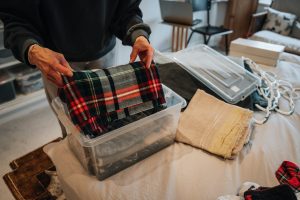 2. Keep the parts of the item(s) that really remind you of that memory the most. If you are struggling to get rid of the clothes your child wore when they were a baby, and now they are a teenager, keep a few of your favorites and donate or give away the rest to a family expecting soon.
Often, new parents get so many gifts for newborns aged 0-3 months that they then struggle to have what they need when the baby is a little older. Babies grow out of things so quickly; parents hate spending too much on each stage, so a donation is greatly appreciated.
3. Make a list of your favorite memories. Find something in the house that represents that memory and eliminate the rest. If you or a child had a successful sporting season of life with multiple trophies, ribbons, certificates, and memorabilia, choose what represents it the most, for example, the trophies from the highest ranks, and take pictures of the rest.
Arrow Hill Cottage lists things we can clear out guilt-free
- Lesser-used items – example towels, cups, kitchenware
- Leftover project materials
- Expired products (Medications, makeup, sunscreen, car seats, bike helmets, spices, canned goods,
- Items for a different season of life
- Out of control collections, not the whole collection (determine a location and when it is full, get rid of something)
- Bulky items you don’t have space for
- Broken items. (We plan to repair them but haven’t.)
- Paper manuals
- Extra packaging or wrapping
- Promotional freebies – t-shirts, plastic cups
Here is a list of ways to approach the task
- The 5/7 rule: keep only what you use 5 out of 7 days a week to clear surfaces.
- One in, two out – for every item you keep, get rid of two
- For every day of the month, get rid of that many items. It can also help to do it backwards: on day 1, get rid of 31; on day 2, get rid of 30
- Start with reducing what comes in. When the mail comes in, go through it immediately to throw away the junk mail. If you don’t have time to pay the bills and file them, put them in a place you will see so you can take care of them.
- When the kids bring home graded papers, look through them and decide which are worth saving and which are not. Help your children decide, by the end of the semester or school year at least, what is worth keeping and what to throw away. Put a year on the items you and your child choose to keep.
- Turn all your hangers backwards. As you wear things and then wash them, put them back on the hanger face forward. Then, after six months, or more if needed, go through your closet and donate any items that are still facing backwards; they are the ones you have not worn and can most likely be donated.
- Rule: Don’t put it down, put it where it goes. For example, don’t take your shoes off in the living room; take them off where they belong. Don’t put the mail down; go through it. Don’t put the dishes in the sink; put them in the dishwasher (if it is empty, that is)
- Don’t leave a room without something in your hand to go to another room. If you are going to the kitchen to get something, check if anything in the room you are in belongs in the kitchen.
If all of this is overwhelming, focus on one thing to do differently. Try one new thing. If it works for you, keep doing it; if it doesn’t, try something else, but keep working at it one item at a time.
Counseling can help
 Letting go of things, whether it is physical items or things we are doing, can cause anxiety and bring up hurtful memories. When we begin doing these things, we realize how liberating they are.
If you are struggling with any of this, counseling can assist you in the process and encourage you through it. Healing from the pain can lead to a clearer mind, reducing what we were doing to try to fill the void and mask the pain. I would love to walk with you through this journey of healing.
Photos:
“Folding Clothes”, Courtesy of Sarah Brown, Unsplash.com, CC0 License; “Storing Blankets”, Courtesy of Cphotos, Unsplash.com, Unsplash+ License; “Donation”, Courtesy of Getty Images, Unsplash.com, Unsplash+ License